

Key Takeaways
- IPM eliminates the root cause of an infestation by prioritizing proactive measures like sealing entry points and removing food sources.
- It focuses on non-toxic methods and habitat changes, using targeted applications as a last line of defense.
- While it may involve more initial effort, it is more cost-effective over time because it prevents the cycle of recurring pests.
- For long-term success, the property owner should manage maintenance, while the pest control company provides specialized monitoring.
- Conventional treatments are used for immediate “knockdown” of active emergencies, while IPM serves as the long-term solution to keep them from returning.
Integrated Pest Management (IPM) is a strategic and sustainable framework for resolving pest issues in Nashville commercial facilities. By leveraging a combination of biological controls, structural modifications, and specialized treatments developed by entomologists, IPM focuses on the root causes of an infestation rather than just managing the symptoms.
Compared to traditional extermination methods, IPM offers a superior risk profile, improved environmental compliance, and more reliable long-term protection for your commercial property across Indiana, Illinois, Missouri, and Kentucky.
How Does IPM Work?
Standard pest control is often associated with routine liquid applications and baits. However, in a professional commercial environment, effective management requires a much more comprehensive strategy. For many common pests found in the Midwest, relying solely on conventional treatments is often not the most efficient or effective allocation of resources for your business.
The objective of Integrated Pest Management is to establish a durable, long-term pest control solution. To reach that milestone, our specialists follow a rigorous three-step IPM protocol:
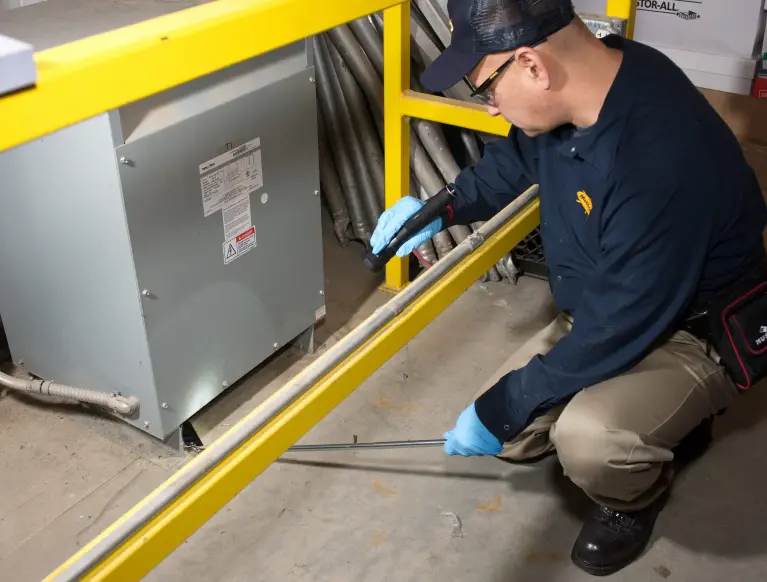
- Facility Assessment: We identify the specific species involved, locate their entry points, and assess the overall risk to the commercial structure.
- Targeted Control: IPM prioritizes managing populations without the immediate deployment of chemical agents. Once mechanical or biological barriers are established, we utilize targeted treatments only as necessary.
- Prevention: We eliminate the environmental variables that attract pests through non-invasive structural modifications, exclusion work, and continuous monitoring.
Integrated Pest Management vs Conventional Pest Control: What’s the Difference?
Both IPM and traditional pest management services have specific roles in a comprehensive facility management plan. For example, if a significant infestation is actively disrupting your business operations or impacting staff, conventional pest control is the best tool for a rapid population knockdown. Once that immediate liability is managed, IPM is the ideal follow-up to secure the property.
These two methods are frequently used in tandem: conventional treatments resolve the active emergency, while IPM is established as the follow-up to ensure pests do not return to the facility.
Does IPM Always Work?
To maximize the value your IPM program brings to your business, it is essential to take an active role as a partner. IPM functions best as a collaborative effort. We rely on your team to monitor activity between our scheduled visits and maintain the daily facility standards that make your business less hospitable to pests.
Essential maintenance protocols include:
- Dispose of waste regularly and store it in heavy-duty, industrial-grade containers.
- Keep basements and crawl spaces dry and well-ventilated to prevent moisture-related issues.
- Monitor for signs of activity like gnaw marks or droppings; identify and seal entry points immediately.
- Seal all cracks and holes on the building exterior, specifically around utility lines and pipes.
- Maintain landscaping by keeping tree branches and shrubbery trimmed away from the structure.
- Replace any decaying exterior wood, which can act as a primary attractant for several insect species.
- Update weather-stripping and repair loose mortar around foundations and windows.
- Ensure a functioning drainage system is in place to channel water away from the foundation.
- Verify that flat roof surfaces are free of standing water.
Is IPM for Commercial Pest Control?
Integrated Pest Management is a high-standard approach designed for commercial properties. We recommend an IPM strategy for any Nashville business where recurring pests have been a persistent issue that traditional methods have failed to resolve.
With standard pest control, the goal is immediate detection and direct treatment for a fast result. With IPM, the goal is long-term results; we achieve that by correcting the root cause so the problem stays solved over the long-term. This makes it a sound financial and operational choice for businesses.
If you are ready to implement Integrated Pest Management in Nashville, the McCloud Pest Solutions team is ready to assist. Contact us today to arrange your comprehensive pest assessment.
Click to view McCloud’s Service Listing
FAQs About Integrated Pest Management
How long does it take to see results in a business setting?
This depends on the specific pest profile. While you may see a reduction in activity within days, the goal is total removal. Because IPM addresses the source, it can take several weeks to fully disrupt the breeding cycle.
Is IPM more expensive than conventional pest control?
The initial audit and structural fixes are labor-intensive and may involve higher upfront costs. However, because it prevents future infestations, it is the more cost-effective choice over the long term by reducing the need for repeated “emergency” visits.
What is the standard service frequency?
Most commercial IPM plans involve quarterly or bi-monthly inspections. The focus is on monitoring—evaluating traps and structural integrity to catch problems before they escalate into a full-scale infestation.
Is it necessary to close the business during treatment?
Typically, no. Because IPM prioritizes physical modifications and utilizes precision baits or gels rather than broad sprays, your business can generally remain operational while the work is performed.
Can IPM solve an active emergency?
Not exclusively. For an immediate crisis, we suggest starting with conventional pest control to reduce the population instantly. Once the situation is stable, we transition to IPM to ensure the problem is solved permanently.
Will IPM affect the local Midwest environment or wildlife?
No. This is a primary benefit of the strategy. By avoiding “blanket sprays” and using pinpoint treatments, IPM protects beneficial insects and prevents chemical runoff that could harm local wildlife or pets near your business.
Is IPM the same as green or organic pest control?
While often grouped together, there are differences. Green or organic pest control typically refers to the product ingredients.
IPM is a methodology focused on proactive exclusion and resource removal. While it is an environmentally responsible choice, IPM may use conventional treatments in a targeted way for maximum efficacy.