

 Key Takeaways:
- Immediately clean up spills and use self-closing waste bins to stop birds using your facility as a feeding ground.
- Seal entry points and gaps in the building exterior, including dock seals and door frames, to prevent birds from accessing warmth and nesting sites inside the facility.
- Remove outdoor storage like pallets and racks that provide birds with protected harborage and nesting sites.
- Report activity early to professional services so they can intervene before birds establish a territory or hatch a brood, which makes them much harder to remove.
- Three of the most common nuisance birds around facilities in Nashville are pigeons, European starlings, and house sparrows.
Practical Ways to Keep Birds Away from the Facility Exterior
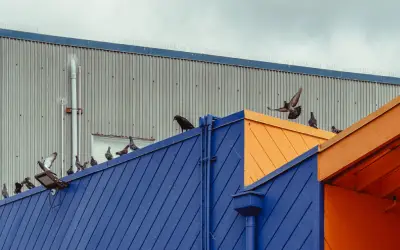
When birds see a facility like yours, they see a great place to nest and roost. They know that food production plants, distribution centers, and other types of processing facilities offer all the resources and amenities they need.
Fortunately, there are some simple ways you can prevent birds from gathering around your facility by making your site less desirable. The following tips can help to keep birds out of your facility.
1. Clean Up Food Spills
Birds have incredibly sharp eyesight and are highly motivated by food. A single dropped cracker or a leaking trash bag can act as a beacon for “scout” birds.
If a scout finds a reliable food source, it may lead more birds to your facility. Cleaning spills immediately disrupts this process, so the area isn’t marked as a feeding ground.
2. Use Waste Receptacles With Self-closing Lids and Empty Garbage Frequently
A self-closing lid ensures that the “human element” — forgetting to close a bin — doesn’t lead to a bird infestation. If a lid is left even partially open, birds like gulls and crows will enter and scatter trash, creating further sanitation issues.
3. Don’t Put Racks and Pallets Outside; They Provide Harborage for Birds
The gaps between slats provide a perfect environment for nesting because they offer protection from predators, the wind, and bad weather.
4. Pest-proof all doors and other openings
Pest-proofing involves inspecting the building exterior for any gaps larger than 1/2 inch and sealing them with durable materials that birds cannot peck through.
Birds are experts at finding places where warm air escapes the building. They will use even the smallest gap in a door frame or a missing vent cover to enter a facility for warmth or nesting.
5. Check Timing Mechanisms on Automatic Doors and Make Sure Doors Seal When They Close
These doors should close approximately 6 seconds after the person enters the building and clears the sensor. If a door lags or stays open too long, it creates an inviting path inside.
The seal is also critical; if the door doesn’t sit flush against the threshold, it leaves a gap that allows birds to hop inside.
6. Ensure Door Seals are Properly Maintained
Open doors are the primary way birds enter warehouses and plants. Dock doors are particularly vulnerable because of their size.
Even when a trailer is present, gaps in the side bumpers or the top “header” seal can allow birds to enter. Ensuring these seals are tight against the trailer creates a continuous barrier that maintains the bird-free integrity of the interior.
7. Contact Your Pest Management Provider at the First Sign of Bird Activity
Early reporting is the most cost-effective way to manage birds. Birds are highly territorial; once they successfully hatch a brood on your signage or dock, they are biologically driven to return to that spot every year.
Your pest management provider should know the ins and outs of bird management. Reporting activity immediately allows your provider to intervene with deterrents before the birds “imprint” on your facility as their home.
How Birds Can Damage Your Facility
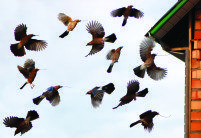
Birds are unsanitary, destructive, and noisy, and the more you have around your facility, the more likely it is that some of them will get inside your facility, increasing the risks.
Whether inside or out, bird infestations pose the following risks:
- Health Hazards: They can spread diseases, such as Salmonella, potentially contaminating food and food contact surfaces.
- Structural Damage: Their acidic droppings can corrode metal, leading to damage to structural damage.
- Property Loss: Birds can contaminate stored products and damage packaging, resulting in costly wastage.
- Safety Concerns: Droppings on sidewalks and other areas create unsightly conditions and slip hazards.
- Fire Risk: Nesting materials present a potential fire hazard.
Contact Your Local Bird Control Experts
Pest bird management is a specialized discipline. It requires expertise in bird biology and behavior, the ability to assess a site accurately, and the experience to design and implement effective, long-term programs. When executed properly, it protects your goods, reputation, and bottom line.
Whether you are dealing with pigeons on a loading dock, starlings in a warehouse, or sparrows nesting in signage, our technicians have the expertise to assist. Contact us or schedule a free pest inspection to get started.
Common Birds Found Around Commercial Facilities
While many bird species are known to nest around food processing, food service, and other commercial facilities, three main varieties are responsible for most infestations:
The most common pest birds are:
1. Pigeons

Signs of pigeons around your facility
| Droppings | Large, white, acidic accumulations (guano) on ledges, sidewalks, and under roosting spots. |
| Nests and nesting material | Flimsy, flat nests made of a few sticks, often held together by dried droppings. |
| Sounds | Near-constant, low-pitched “cooing” and the sound of heavy flapping/scraping on metal ductwork. |
2. European Starlings
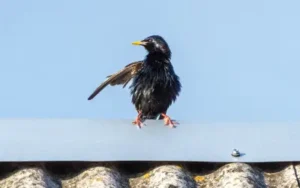
Signs of European starlings around your facility
| Frequent entry/exit | Noticing birds disappear into small holes in siding, eaves, or vents. |
| Huge flocks | These are also known as “murmurations,” and they often appear to move in sync. They can easily overwhelm trees or rooflines around dusk, when they’re most active. |
| Nesting material | Large, messy “cup” nests stuffed into cavities, often made of grass, pine needles, and feathers. |
3. House Sparrow
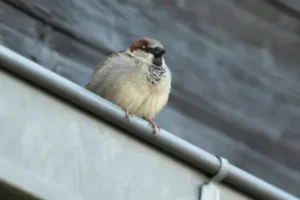
Signs of house sparrows around your facility
| Hopping behavior | Sparrows have a distinctive “hop.” It’s how they get around on the ground rather than walking. |
| Nests in elevated corners | They love rafters, especially near heaters or lights for warmth. |
| Insulation damage | Sparrows like to peck and gather fiberglass or foam insulation to use as nesting material. |
What Will Deter Birds from Building a Nest
To keep birds out of your facility and deter them from building nests requires a combination of physical deterrents and habitat modification. The most effective long-term solutions include:
- Bird netting: This system provides a humane barrier to keep birds out of large areas like warehouses and overhangs, preventing birds from accessing structural beams. Each installation is customized to match your facility’s specific layout
- Bird spikes: These prevent birds from perching on ledges, signs, and rooftops by making the surfaces uncomfortable for landing
- Electric deterrents: These emit a short, harmless pulse that teaches birds to avoid certain surfaces, such as roof peaks, beams, and ledges
- Perch modification systems: Wire deterrents and bird coil systems make flat surfaces harder for birds to use for roosting
- Behavior-altering deterrents: sound and scent-based repellents train nuisance birds to avoid certain areas without harming them
Some DIY deterrents, like store-bought spikes or reflective devices, can offer short-term relief, but professional bird management provides a more reliable, long-lasting solution.
Learn how to keep birds out of open buildings and which solutions are available for your site.
What to Do If a Bird Enters the Facility
Once birds settle in and find steady food and shelter, getting them to leave your facility becomes much harder. On top of that, many species are protected by state and federal laws, which limit how you can legally handle them.
Give our commercial bird control experts a call as soon as you notice a problem. We’ll come out to take a look, figure out exactly what’s going on, and put together a plan that works for your business now and for the long haul.
Ready to get started with your complimentary inspection? Call us today.
Frequently Asked Questions about Bird Prevention
What Are the Best Long-Term Solutions to Keep Birds Out of Commercial Facilities?
The most effective long-term solutions combine physical deterrents with habitat modification to remove food sources and nesting opportunities. A professionally designed plan tailored to your facility and the specific bird species present will deliver the most reliable results.
How Can You Bird-Proof a Facility Without Affecting Daily Operations?
Most bird-proofing measures, including installing netting, sealing gaps, and adding perch deterrents, can be completed with minimal disruption. McCloud’s technicians coordinate service visits to accommodate your schedule and maintain smooth operations.
Which Areas of a Facility Are Most Vulnerable to Bird Entry?
Dock doors, personnel doors, loading bays, roof vents, soffits, and gaps in corrugated siding are common entry points. HVAC units and overhangs are also frequent roosting and nesting sites that require regular inspection.
How Often Should Bird Control Measures Be Inspected or Maintained?
At a minimum, bird deterrents and exclusion measures should be inspected seasonally. Early reporting of new activity remains the most cost-effective approach.