

If you run a business that stores, processes, or sells grain and dry goods, you know how much work goes into protecting your products. But even the most careful operations can fall victim to stored product pests.
These tiny invaders can destroy your inventory, contaminate your goods, damage your equipment, and put your entire operation at risk. Failed inspections, facility shutdowns, and a damaged reputation are all real possibilities when stored product pests in businesses go unchecked.
At McCloud Pest Solutions, we’ve seen firsthand how quickly these pests can spread and how effective the right prevention and treatment strategies can be. Each stored product pest has its own habits, preferred foods, and warning signs.
Types of Stored Product Pests
Indian Meal Moth
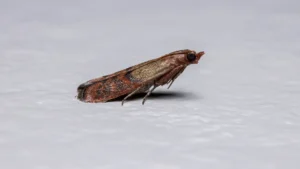
The Indian meal moth is one of the most widespread stored product pests in the food industry.
What makes them so troublesome is their larvae. The caterpillars spin silken webs as they feed, leaving behind a sticky mess that clumps products together and makes them unsellable. Their webbing is often one of the first signs of an infestation.
Adult moths have distinctive wings: the outer half is bronze or copper, while the inner half is grayish-white.
Warehouse Beetle
The Warehouse Beetle is a serious concern for any business that stores dry goods.
One of the biggest challenges with Warehouse Beetles is their ability to survive in tiny amounts of food debris. Even a small spill in a corner or crack can support a growing population.
They’re also covered in tiny hairs that can contaminate products and even cause allergic reactions in some people.
Warehouse beetles are oval-shaped, dark brown to black, with lighter colored patterns on their wings.
Rice Weevil
As the name suggests, rice is the rice weevil’s favorite food, but they also go after wheat, corn, barley, and other cereal grains.
Rice Weevils can fly, which helps them spread throughout a facility. They’re also known to infest grain before it even reaches your warehouse, hitching a ride in shipments from suppliers.
Adult Rice Weevils are small, reddish-brown beetles with a distinctive long snout.
Drugstore Beetle
The drugstore beetle gets its name from its habit of infesting pharmacies and drugstores, where it feeds on a surprisingly wide range of materials, including medications.
Even products you wouldn’t expect, like dried flower arrangements or spices, can harbor infestations.
These beetles are reddish-brown and have a rounded, hump-backed appearance.
Flour Beetle
There are two common types of flour beetles: the red flour beetle and the confused flour beetle.
Flour beetles don’t attack whole grains. Instead, they prefer products that have already been processed, like flour, cake mixes, and cereal.
Red flour beetles and confused flour beetles look very similar. Both are small, flat, and reddish-brown. The main difference is in the shape of their antennae and their ability to fly (red flour beetles can fly, while confused flour beetles cannot).
Merchant Grain Beetle
The merchant grain beetle loves oily foods, and is often found in facilities that store nuts, seeds, cereals, dried fruits, and chocolate.
One of the biggest concerns with merchant grain beetles is their ability to infest sealed packages. Their flat bodies let them slip through gaps that seem impossible to penetrate.
The merchant grain beetle is small, flat, and brown, with distinctive saw-like teeth on the sides of their thorax.
Cigarette Beetle
The cigarette beetle is notorious for getting into tobacco products along with a wide range of dry goods, including spices, dried herbs, cereals, pet food, dried flowers, and even some paper products.
The beetles are about an eighth of an inch long and have a rounded, hump-backed shape similar to the drugstore beetle. The main difference between these beetles is in their antennae. Cigarette beetles have saw-like antennae, while drugstore beetles have club-shaped antennae at the tips.
Sawtoothed Grain Beetle
These beetles get their name from the six saw-like teeth on each side of their thorax, similar to their merchant grain cousins.
They prefer products that have already been broken or processed, such as flour, cereal, bread, pasta, dried fruits, and sugar. Because of their flat shape, Sawtoothed Grain Beetles can get into packaging that seems tightly sealed.
Signs of a Stored Product Pest Infestation
The longer pests go unnoticed, the more damage they cause and the harder they become to eliminate:
- Seeing adult insects
- Damaged packaging
- Webbing (for moths)
- Frass (droppings)
- Unusual odors
- Larvae or grubs
How to Deal With Stored Product Pests
No matter which approach you take, ongoing vigilance is key. Stored product pests are persistent, and new infestations can start at any time, especially if infested goods are brought in from outside suppliers. Regular inspections, monitoring, and professional support are the best ways to stay ahead of these pests.
Over-the-counter products and DIY approaches rarely solve stored product pest problems, especially in large commercial facilities. Professional use targeted treatments, such as fumigation, conventional insecticide applications, and ultra-low volume treatments, to eliminate pests at all life stages. Fumigation is one of the most effective options for severe infestations. This method uses gas to penetrate stored products and hard-to-reach areas, killing pests at every stage of development.
If you suspect you have a pest problem, you have to act swiftly. The longer pests remain unchecked, the more they’ll spread. That’s why bringing in professional exterminators is the best way to deal with stored product pests. At McCloud Pest Solutions, we deal with these infestations every day.
Rely on McCloud Pest Solutions to Protect Your Business
Dealing with stored product pests in businesses is stressful and time-consuming. These pests are experts at hiding, and trying to handle them on your own is like searching for a needle in a haystack. Without the right tools and expertise, it’s easy to miss the signs of an infestation until the damage is already done.
Partnering with McCloud Services means simplified compliance with thorough documentation, cost savings through affordable prevention, and peace of mind knowing your facility is protected. Our approach is built on four key steps: identification, prevention, monitoring, and suppression. Integrated Pest Management (IPM) is also our standard approach to pest elimination.
Contact McCloud Pest Solutions today to schedule your free assessment and see what sets us apart.
← Back to Professional Stored Product Pest Prevention